
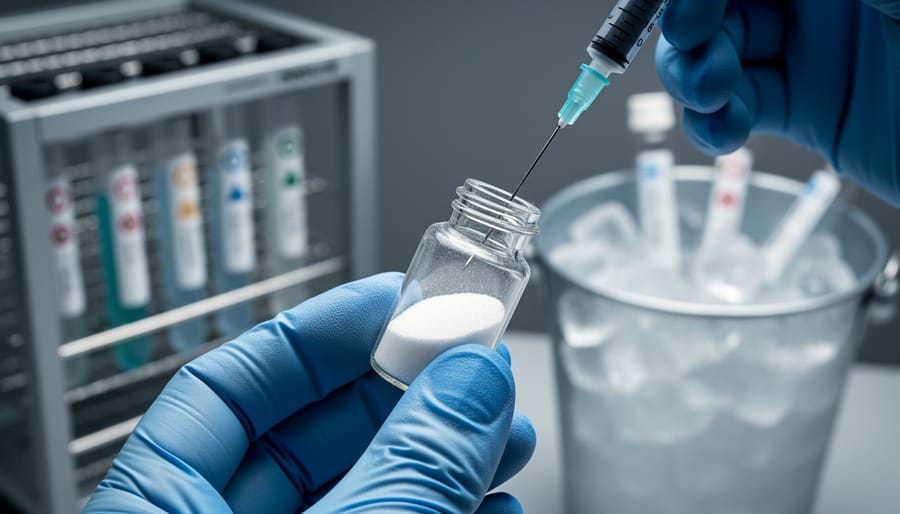
Reconstituting a 10 mg Selank vial from https://kylopeptides.com/product/selank-10-mg/ takes about ten minutes and one rule: keep everything cold, clean, and gentle. Store the lyophilized powder sealed and refrigerated or frozen per the supplier’s sheet, let the vial reach room temperature before opening, add sterile diluent slowly down the vial wall, and swirl until clear. Never shake it. Difficulty is low, but the margin for error is thin, because a peptide this small degrades quickly when it’s warmed, agitated, or contaminated.
If you’re working with this product, the same logic applies to any research-grade lyophilized peptide. The powder is stable. The solution is not. Most degradation happens in the minutes after mixing and in the weeks after, so technique and storage decide whether your results mean anything.
This guide covers the materials you need, the conditions that should make you stop and discard, a numbered reconstitution procedure, storage for both dry and mixed forms, and how to verify and troubleshoot. It’s written strictly for laboratory research use. For exact stability windows and diluent recommendations, the certificate of analysis and supplier documentation take precedence over any general rule of thumb.
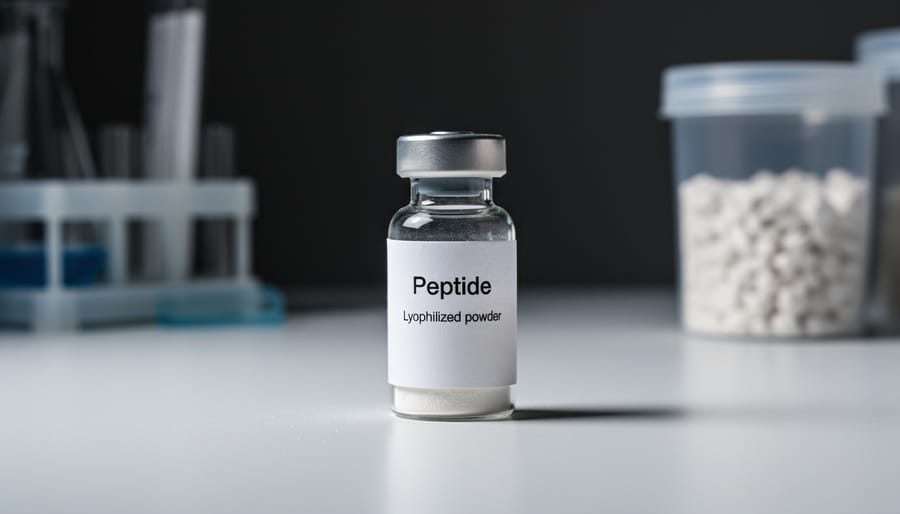
A freeze-dried 10 mg Selank vial is a peptide that has been deliberately dried so it can survive shipping and shelf time. Once you add liquid, you give up much of that protection, which is why handling matters on both sides of reconstitution.
In the dry state, the peptide sits as a lyophilized cake, usually a small white pellet or thin film clinging to the bottom or walls of the vial. It can look sparse or even invisible, and a film is no sign that the vial is underfilled. Freeze-drying leaves a porous, low-moisture solid, and with little water present, the chemical reactions that break peptides down slow to a crawl. That’s why lyophilized material tolerates storage far better than any solution made from it.
After reconstitution, the picture flips. Dissolved peptide is exposed to water, so hydrolysis, oxidation, and microbial growth all become real concerns. The main threats are moisture (before you intend it), heat, light, and rough agitation such as shaking or foaming, which can damage the molecule or leave it aggregated.
Stability figures vary by supplier and formulation, so treat generic rules as a starting point only. Your certificate of analysis and the supplier’s handling sheet should set the actual storage temperatures and time limits you follow.
The diluent volume you pick sets the concentration, so decide it before the needle touches the vial. Concentration is simply mass divided by volume. A 10 mg vial mixed with 2 mL of diluent gives 5 mg/mL; the same vial in 1 mL gives 10 mg/mL, and in 5 mL gives 2 mg/mL. Write that math in your log first, then draw the liquid. Recording it afterward invites mistakes, especially if the label goes missing.
Which diluent you choose depends on how you’ll use the solution. Bacteriostatic water contains a preservative that supports multiple draws from one vial. Sterile water has no preservative, so it suits single-use aliquots that are used once and discarded.
Have this checklist ready before you start:
Confirm your volume and concentration against the supplier’s documentation, since handling guidance can differ between products.
Selank sold as a research peptide is for laboratory use only. It is not an approved medicine, and nothing in this guide covers human or animal administration. Treat that boundary as part of your research responsibility and follow your institution’s policies and the supplier’s safety data sheet before you touch a vial.
Keep safety first as the working rule at the bench. Wear gloves, wipe your work surface with alcohol before you start, and keep food, drinks and unrelated materials away from the area. Contamination is the quiet risk here. A single unclean stopper wipe or a reused syringe can spoil an entire vial, and you may not see it happening.
Handle sharps deliberately. Never recap a used needle, and don’t carry one across the room. Drop it straight into a rigid sharps container, and dispose of it according to your facility’s rules.
Stop, and do not use the vial, if any of these apply:
– The vial is cracked, the seal is broken, or the stopper looks loose or punctured.
– The powder is discolored or clumped, or it looks wet or shrunken.
– The solution turns cloudy or contains particles after mixing.
– You can’t confirm where the vial has been stored or for how long.
– The vial went through a temperature excursion beyond what the supplier’s documentation allows.
When any of these show up, discarding the vial costs far less than building results on compromised material. Don’t try to rescue it, and don’t guess. If you’re unsure whether a deviation matters, check the supplier’s handling sheet or ask your lab supervisor before going further.
Unopened lyophilized Selank is the most stable form you will ever hold, so the goal here is simply not to undo that stability. Start with the supplier’s handling sheet. Most suppliers call for refrigerated or frozen storage, and their stated temperature always overrides general advice.
Whatever the temperature, keep the vials dry and shielded from light. Put the vials in a sealed secondary container, such as a small airtight box or a zip bag, and add a desiccant packet if you have one. This keeps ambient moisture off the cake and gives you a second barrier if a vial leaks. It’s a good habit to store in the dark since light exposure is another quiet source of degradation.
Label each vial the day it arrives. Record the receipt date and the lot number, and match them to the certificate of analysis. If a question comes up later, you’ll know exactly what you have and how long it has been held.
Before opening, let the vial reach room temperature on the bench. A cold vial opened in warm air pulls in condensation, and that moisture is exactly what lyophilized peptide doesn’t tolerate. Give it enough time to warm fully, and keep the stopper sealed until then.
Finally, limit how often the stock moves. Pulling vials in and out of the freezer repeatedly creates temperature swings and freeze-thaw stress. Take out only what you plan to use, and keep the rest undisturbed in its container.
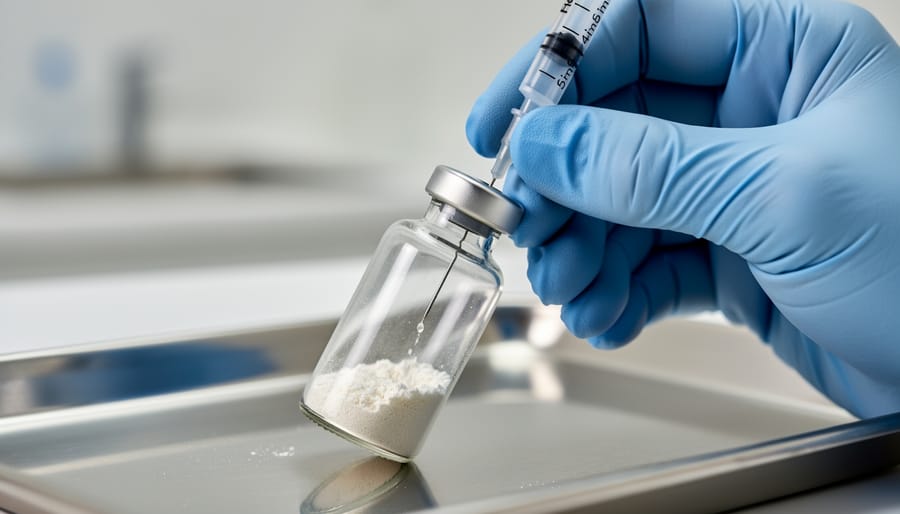
Reconstitution is a short job, but each step protects the peptide from heat, contamination, or physical stress. Work through the steps in order, and keep the vial closed until everything is within reach.
If the powder is slow to dissolve, give it a few more minutes of gentle swirling instead of shaking harder. Dissolving takes patience, not force. If you plan to split the solution into aliquots, do it right after the clarity check, before returning anything to cold storage. And if the solution turns cloudy or shows particles, stop and treat the vial as questionable rather than pushing ahead with it.
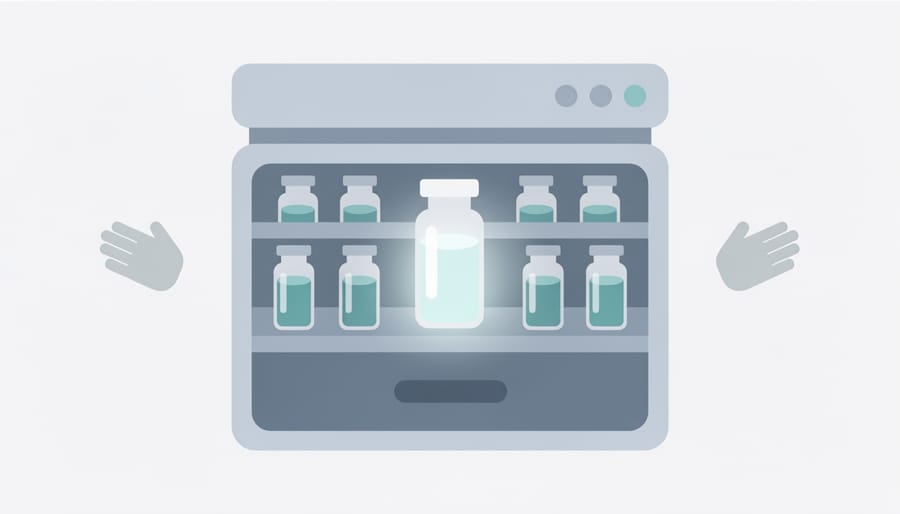
Once the vial is mixed, treat the solution as the fragile part of the workflow. Store it in a calibrated refrigerator, in its original vial or a clean sealed tube, away from light. Wrap it in foil or keep it in an opaque secondary box. Wipe the stopper with a fresh alcohol swab before every access and let it dry, so you never push residue or contamination back into the liquid.
Every needle puncture is a small contamination risk, and every temperature swing stresses the peptide. That’s why splitting the batch into single-use aliquots makes sense. Draw the solution into sterile, clearly sized tubes or vials soon after mixing, so each one is opened once and then discarded or used up. If your protocol calls for freezing aliquots, freeze them once and avoid thawing and refreezing, since repeated freeze-thaw cycles are a common way to degrade a peptide.
Expect a much shorter shelf life than the dry powder offers. A lyophilized vial can sit for long stretches under proper conditions, while a reconstituted solution may only hold for days or weeks. Don’t guess at the number. Take it from the supplier’s documentation and your own lab protocol, and when in doubt, discard.
Give each aliquot a durable identifier the moment you fill it, and label and track the lot number, mixing date, concentration and storage location so nothing ever sits in the fridge unidentified.
Most problems at the bench trace back to rushing. Cloudy or particulate solution means stop: don’t filter it or hope it clears, discard it and remix from a fresh vial. Powder that dissolves slowly usually just needs more time, so let the vial sit at room temperature and swirl gently rather than reaching for the vortex. Foaming comes from over-agitation or a diluent stream hitting the cake directly. Let the foam settle, and if the solution isn’t clear and uniform afterward, treat it as compromised. A vial that lost its label is unidentifiable material, so discard it. Relabeling from memory is how mix-ups happen.
Shelf life after mixing is much shorter than for the dry powder and depends on the diluent and conditions. Set it from the supplier’s documentation and your lab protocol rather than guessing.
No. Shaking causes foaming and can stress the peptide. Swirl gently and give it time.
Only if the supplier’s guidance allows it, and ideally as single-use aliquots to avoid repeated freeze-thaw cycles.
Only within the limits your supplier and lab protocol set for multi-draw use, keeping the stopper clean and the vial cold. When in doubt, discard it.
When a result looks off, discarding costs far less than running experiments on questionable material.
Handling a 10 mg Selank vial comes down to a short, repeatable routine. Keep dry vials cold, dark, and sealed until you need them. Let a vial warm to room temperature before you open it, then reconstitute gently with a calculated volume of sterile diluent, angling the stream down the glass and swirling instead of shaking. Label the solution, split it into aliquots, and refrigerate it. If anything looks cloudy, discolored, or off, discard it rather than gamble on it.
Always defer to your supplier’s documentation and your institution’s lab policy for exact stability limits, and keep clear records of lot numbers, dates, volumes, and storage temperatures.